

Every transformation begins with a quiet undoing.
Long before the world paused, something within me had already begun to loosen. Around 2018, a subtle restlessness surfaced — not dramatic enough to force change, but persistent enough to whisper: this chapter is ending.
I had built my identity around being a makeup artist. It was what I did. It was who I was. And yet, beneath the surface, a question was forming.
Then the world fell silent.
When the Covid-19 pandemic arrived and lockdowns made it impossible to continue my work, the structure I had relied on dissolved overnight. What once felt stable suddenly had no ground. And in that stillness, a deeper question rose:
If this role disappears… who remains?
If the title falls away… what is left?
Ashes of Earth holds that moment of suspension — the space between who I had been and who I had not yet remembered myself to be. The breath of the duduk carries a sense of mourning, like wind moving through ruins. The harp’s gentle arpeggios flicker like distant light. Beneath it all, the cello pulses forward — quiet, steady — as if something unseen is already in motion.
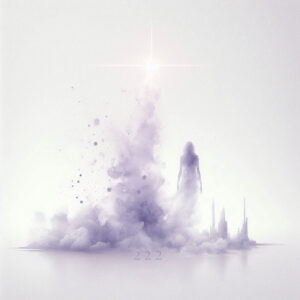
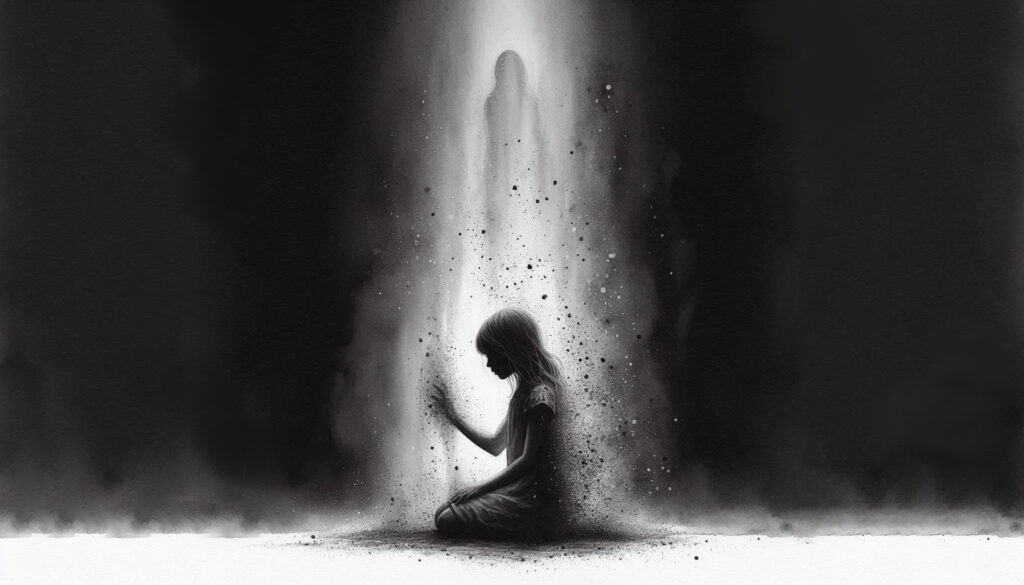
The EP’s visual language was shaped by a dream: I was inside a spacecraft, leaving Earth. As I looked through the window, I saw a figure reaching outward, their body dissolving into dust, slowly disintegrating into the air.
It did not feel violent.
It felt inevitable.
A form returning to particles.
An identity shedding its shell.
That image became the seed of EP 222.
Ashes of Earth is the first chapter in that arc — the dissolution before the signal is sent, the collapse before the search begins. What follows in the next tracks is not destruction, but transmission… remembrance… and emergence.
Before there is a new dawn, there must be ashes.
Where the old self turns to dust.
Where the old self turns to dust.